
Healthcare has always evolved alongside technology. From medical imaging and electronic health records to robotic surgery and remote monitoring, every major advancement has changed how diseases are understood and treated. Today, artificial intelligence (AI) is becoming one of the most influential developments in modern medical technology.
AI in healthcare is no longer limited to research laboratories or experimental systems. It is increasingly integrated into clinical decision-making, diagnostics, patient engagement, hospital operations, and medical research. Its value comes not from replacing healthcare professionals but from improving speed, accuracy, scalability, and access to care.
As healthcare systems worldwide face growing patient demand, rising costs, and increasing data complexity, AI is emerging as a foundational technology that connects medical data, clinical knowledge, and real-world outcomes.
Understanding AI in Healthcare
Artificial intelligence in healthcare refers to computational systems that perform tasks traditionally requiring human intelligence. These tasks include recognizing patterns, making predictions, analyzing large datasets, understanding language, and supporting decision-making.
Healthcare AI often combines several technologies:
- Machine learning (ML)
- Deep learning
- Natural language processing (NLP)
- Computer vision
- Predictive analytics
- Generative AI
- Clinical decision support systems
Unlike traditional software that follows fixed rules, AI systems improve performance through exposure to data.
For example:
- A radiology model can learn to detect abnormalities in scans.
- A predictive system can estimate patient deterioration risk.
- An NLP engine can summarize physician notes.
- Research platforms can identify potential drug candidates.
The real power of AI appears when these systems work alongside clinicians and healthcare infrastructure.
Why AI Matters in Modern Medical Technology
Healthcare generates enormous amounts of information every day.
This includes:
- Electronic health records (EHRs)
- Medical imaging
- Laboratory results
- Genomic sequences
- Clinical notes
- Wearable device data
- Insurance and operational records
Most healthcare organizations struggle to convert this data into actionable insights.
AI helps bridge that gap.
Its role is not simply automation. It supports:
- Faster analysis
- Improved diagnostic precision
- Better patient outcomes
- Reduced administrative burden
- More personalized treatment
Medical technology increasingly depends on the ability to transform data into decisions.
Core Applications of AI in Healthcare
1. AI-Assisted Medical Diagnosis
Diagnosis remains one of the most impactful areas for AI adoption.
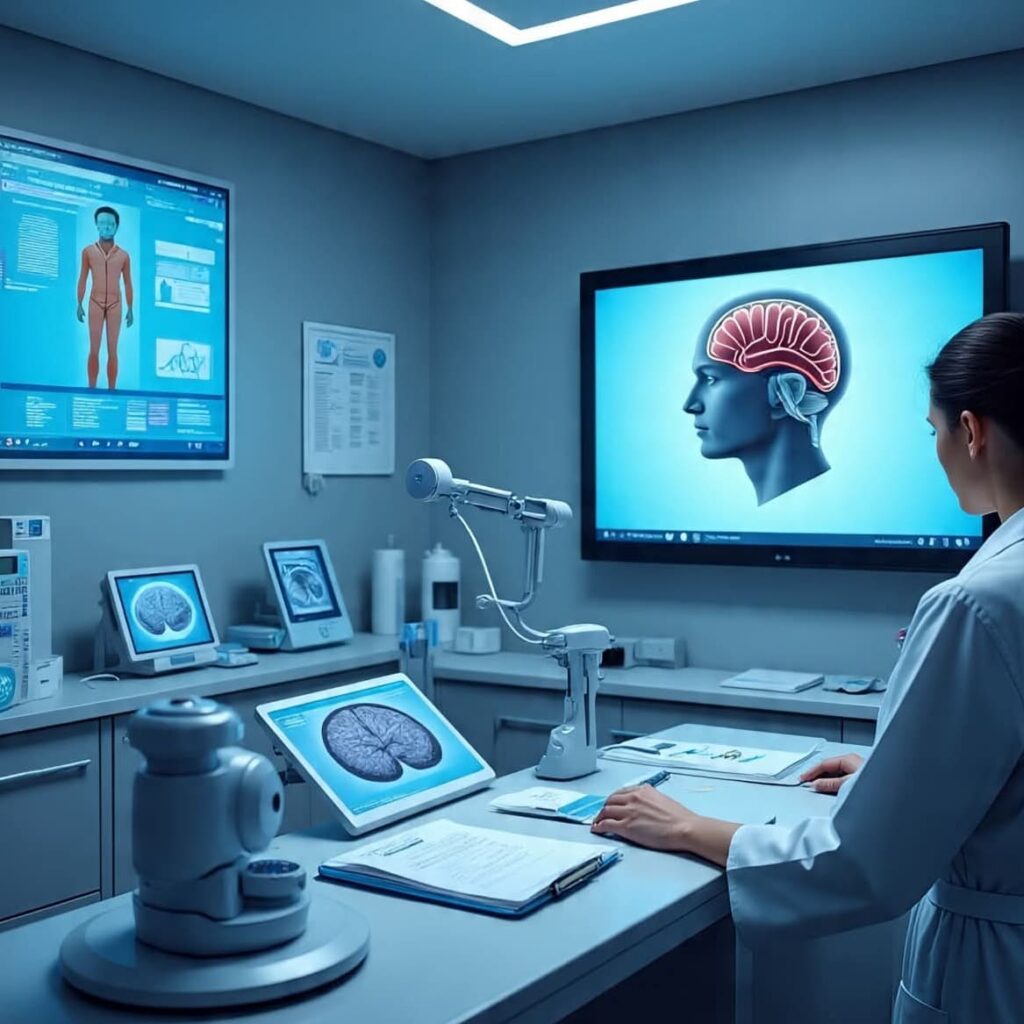
AI systems can process imaging, pathology, laboratory findings, and patient history to support clinical interpretation.
Examples include:
- Detecting tumors in radiology scans
- Identifying diabetic retinopathy in eye imaging
- Recognizing skin lesion patterns
- Supporting cardiovascular risk assessment
- Detecting early neurological changes
Computer vision models analyze patterns that may not be immediately visible to the human eye.
This improves consistency and enables earlier intervention.
Importantly, AI supports physicians rather than functioning independently.
2. Predictive Analytics and Preventive Medicine
Traditional healthcare often reacts after disease develops.
AI shifts healthcare toward prediction and prevention.
Predictive models evaluate historical and real-time patient information to identify:
- Disease progression risk
- Hospital readmission probability
- Infection likelihood
- Population health trends
- Potential complications
For example, hospitals may use predictive algorithms to identify patients at risk of sepsis before symptoms become severe.
Preventive healthcare supported by AI creates opportunities for earlier treatment and lower healthcare costs.
3. Personalized and Precision Medicine
Patients with the same diagnosis may respond differently to treatment.
Precision medicine attempts to customize care based on:
- Genetics
- Lifestyle
- Clinical history
- Environmental factors
- Biomarker profiles
AI enables the processing of these highly complex variables.
Machine learning models can identify treatment pathways more likely to produce successful outcomes.
Applications include:
- Cancer therapy selection
- Personalized medication planning
- Genetic disease analysis
- Individualized treatment recommendations
This relationship between AI and precision medicine is reshaping patient-centered care.
4. Medical Imaging and Clinical Interpretation
Medical imaging generates some of the richest healthcare datasets.
AI enhances interpretation across:
- MRI
- CT scans
- Ultrasound
- X-rays
- Mammography
Deep learning models help prioritize urgent findings and reduce diagnostic delays.
Radiologists remain central to interpretation, but AI can improve workflow efficiency and reduce repetitive analysis.
This creates a hybrid model where clinical expertise and computational analysis complement one another.
AI in Medical Research: Accelerating Scientific Discovery
Medical research is one of the fastest-growing areas of healthcare AI.
Traditional research processes often require years of experimentation, validation, and clinical evaluation.
AI shortens discovery cycles by analyzing large-scale datasets more efficiently.
Drug Discovery and Development
Developing new therapies is expensive and time intensive.
AI assists by:
- Identifying molecular targets
- Predicting compound interactions
- Modeling biological responses
- Prioritizing candidate molecules
Researchers can screen thousands of possibilities before laboratory testing begins.
This reduces cost and accelerates development timelines.

Clinical Trial Optimization
Clinical trials frequently face challenges including:
- Participant recruitment
- Patient matching
- Retention
- Data analysis
AI improves efficiency by:
- Identifying eligible participants
- Predicting enrollment outcomes
- Monitoring safety signals
- Analyzing trial performance
Better trial design can improve evidence quality and reduce delays.
Genomics and Biomedical Research
Genomic data contains massive biological complexity.
AI enables researchers to identify relationships among:
- DNA sequences
- Gene expression
- Disease pathways
- Biomarkers
These insights support advances in oncology, rare disease research, and precision therapeutics.
AI and Hospital Operations
AI affects more than direct patient care.
Healthcare systems also apply AI operationally.
Common applications include:
Administrative Automation
- Documentation support
- Medical coding
- Scheduling optimization
- Billing workflows
Resource Management
- Bed allocation
- Staffing optimization
- Demand forecasting
Supply Chain Intelligence
- Inventory management
- Equipment utilization
- Procurement forecasting
Operational efficiency indirectly improves patient experience and system sustainability.
Remote Care, Telemedicine, and Digital Health
Healthcare increasingly extends beyond hospital walls.
AI strengthens digital health ecosystems through:
- Remote patient monitoring
- Virtual consultations
- Wearable technologies
- Continuous health tracking
Devices collect real-time physiological signals including:
- Heart rate
- Blood pressure
- Oxygen saturation
- Sleep metrics
AI converts these signals into alerts and health insights.
This model supports chronic disease management and expands access to underserved populations.
Challenges and Risks of AI in Healthcare
Despite rapid progress, implementation remains complex.
Data Quality and Interoperability
AI performance depends heavily on data quality.
Healthcare data often suffers from:
- Inconsistent formatting
- Missing records
- Fragmented systems
Poor input reduces model reliability.
Bias and Fairness
Algorithms trained on limited populations may generate unequal outcomes.
Potential risks include:
- Demographic bias
- Unequal diagnostic accuracy
- Underrepresentation
Responsible AI development requires diverse and representative datasets.
Privacy and Security
Healthcare information is highly sensitive.
Organizations must address:
- Data governance
- Encryption
- Consent management
- Cybersecurity controls
Trust remains essential for adoption.
Explainability and Clinical Trust
Healthcare professionals need transparent systems.
Black-box outputs without explanation create barriers to adoption.
Explainable AI focuses on making predictions understandable and clinically interpretable.
Best Practices for Responsible AI Adoption
Organizations implementing AI in healthcare should focus on:
- Define measurable clinical objectives.
- Maintain high-quality datasets.
- Validate models continuously.
- Include clinicians in system design.
- Prioritize patient privacy.
- Monitor real-world outcomes.
- Establish governance frameworks.
- Improve interoperability across systems.
Successful implementation combines technology, regulation, and clinical expertise.
The Future of AI and Medical Technology
Healthcare is moving toward intelligent, connected ecosystems.
Emerging directions include:
- Generative AI for clinical documentation
- Digital twins for treatment simulation
- Federated learning for privacy-preserving research
- Multimodal healthcare AI
- Robotics integration
- AI-powered population health systems
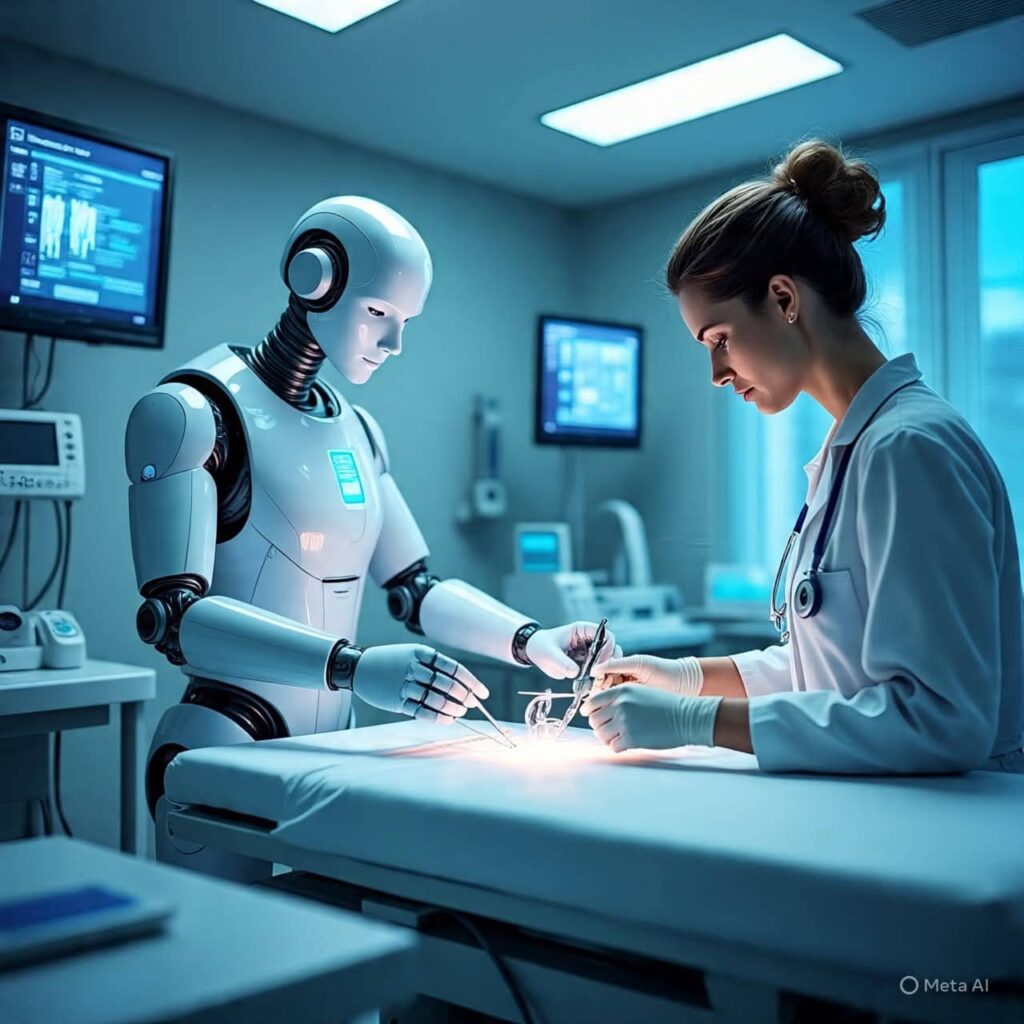
Future medical technology will likely combine human expertise with machine intelligence rather than replace healthcare professionals.
The strongest healthcare systems may become those that integrate data, evidence, and patient-centered care most effectively.
Frequently Asked Questions
AI in healthcare refers to technologies that analyze medical information and support diagnosis, treatment planning, operations, and research through computational intelligence.
AI helps accelerate drug discovery, improve clinical trial design, analyze genomic data, and identify patterns in biomedical datasets.
No. AI is designed to assist healthcare professionals by improving efficiency and supporting decisions, not replacing clinical expertise
Major benefits include faster diagnosis, personalized care, operational efficiency, improved research productivity, and expanded healthcare access.
Key concerns include bias, privacy challenges, poor data quality, cybersecurity risks, and lack of model transparency.
AI enables earlier detection, predictive insights, tailored treatment plans, and better monitoring of patient health.
AI models learn from healthcare data. Better data quality generally improves prediction accuracy and reliability.
Biotechnology, pharmaceuticals, medical devices, cloud computing, genomics, digital health, and biomedical engineering are strongly connected.
Conclusion
AI in healthcare represents a broader transformation in medical technology rather than a single innovation. It connects data, clinical expertise, research, and patient outcomes into a more intelligent healthcare ecosystem.
Its influence spans diagnosis, medical imaging, precision medicine, hospital operations, and scientific discovery. AI in medical research is accelerating how therapies are developed and how diseases are understood.
At the same time, success depends on responsible implementation, transparent systems, strong governance, and meaningful collaboration between technology and healthcare professionals.
The future of healthcare is unlikely to be fully automated. Instead, it will be increasingly augmented, where human judgment and intelligent systems work together to deliver more effective, accessible, and personalized care worldwide.
References
- World Health Organization (WHO) – Ethics and Governance of Artificial Intelligence for Health
- U.S. Food and Drug Administration (FDA) – Artificial Intelligence and Machine Learning (AI/ML)-Enabled Medical Devices
- PubMed – Artificial Intelligence in Healthcare Research
- Mayo Clinic – Artificial Intelligence in Healthcare