

Cancer care is becoming increasingly data-driven. Every cancer patient may generate large amounts of information from medical imaging, pathology reports, genomic testing, electronic health records, laboratory results, and treatment history. Artificial intelligence (AI) can help clinicians analyze this information and identify patterns that may be difficult to recognize manually.
AI in oncology refers to the use of artificial intelligence, machine learning, deep learning, natural language processing, and related technologies across cancer prevention, diagnosis, treatment planning, monitoring, and research.
One important application is AI for cancer treatment planning, where algorithms can help clinicians interpret patient-specific data, evaluate treatment options, predict potential responses, and support personalized care. AI does not replace oncologists. Instead, it provides decision-support tools that can help cancer teams make better-informed clinical decisions.
What Is AI in Oncology?
AI in oncology is the application of computational models to cancer-related clinical and research problems. These systems can process structured and unstructured medical data and identify relationships between patient characteristics, cancer biology, treatment, and outcomes.
Several AI technologies are particularly important:
- Machine learning: Learns patterns from clinical datasets and makes predictions.
- Deep learning: Uses neural networks to analyze complex data such as medical images.
- Natural language processing (NLP): Extracts useful information from clinical notes, pathology reports, and medical records.
- Computer vision: Helps analyze radiology and pathology images.
- Predictive analytics: Estimates risks such as disease progression or treatment response.
- Generative AI: Can assist with summarizing medical information, documentation, and research workflows when appropriately validated.
These technologies can be applied throughout the cancer care pathway rather than being limited to diagnosis.
How AI Is Used in Cancer Care
AI can support multiple stages of oncology, from detecting suspicious abnormalities to monitoring patients after treatment.
1. Cancer Detection and Diagnosis
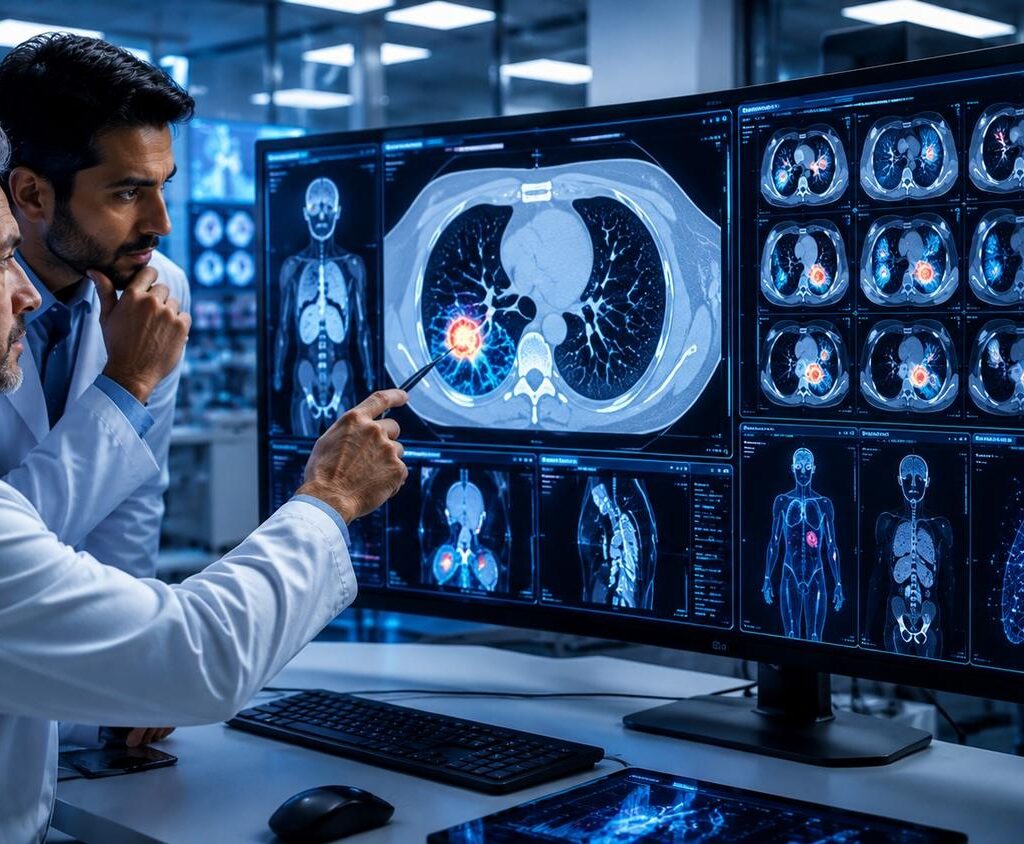
Medical imaging is one of the most established areas for AI applications in oncology. Deep-learning systems can analyze CT scans, MRI examinations, mammograms, PET scans, and other imaging modalities to identify suspicious lesions or abnormalities.
For example, an AI system may analyze a lung CT scan and highlight pulmonary nodules that require further evaluation. In breast cancer screening, AI can assist with mammographic image interpretation.
Pathology is another major application. Digital pathology converts tissue slides into high-resolution digital images. Computer vision models can then help identify cancerous cells, classify tumors, and quantify characteristics such as tumor morphology.
AI therefore acts as an additional analytical layer between medical data and clinical interpretation. The final diagnosis still requires appropriate clinical and pathological evaluation.
2. AI for Cancer Treatment Planning

AI for cancer treatment planning aims to help oncology teams determine which treatment strategies may be appropriate for an individual patient.
Cancer treatment decisions can involve many variables, including:
- Cancer type and stage
- Tumor location
- Histological characteristics
- Molecular and genomic information
- Patient age and overall health
- Previous treatments
- Biomarkers
- Expected treatment response
- Potential adverse effects
AI models can integrate some of these variables and generate predictions that may support clinical decision-making.
In radiation oncology, for example, AI can assist with image segmentation and treatment planning. Automatically identifying tumors and nearby organs can reduce repetitive manual work and potentially improve workflow efficiency.
In systemic therapy, predictive models may analyze clinical and molecular data to estimate how a tumor might respond to particular therapies. These predictions can contribute to precision oncology, although they must be clinically validated before being relied upon for patient care.
3. Precision Oncology and Genomic Analysis

Modern oncology increasingly recognizes that cancers with the same anatomical location can have very different biological characteristics.
Genomic testing can identify mutations, gene-expression patterns, biomarkers, and other molecular features associated with a tumor. AI can help researchers and clinicians analyze these complex datasets.
For example, machine-learning models can identify relationships between molecular alterations and treatment outcomes. This may help researchers discover potential therapeutic targets or identify patients who could benefit from particular treatments.
The relationship can be summarized as:
Patient data → tumor characteristics → molecular profile → AI-supported analysis → potential treatment options → clinical decision
This approach forms part of the broader field of precision medicine, where treatment decisions are increasingly tailored to individual patient characteristics.
4. Predicting Treatment Response
One of the most important goals of AI-assisted oncology is predicting how a patient may respond to treatment.
Traditional clinical decision-making often relies on population-level evidence from clinical trials and established treatment guidelines. AI can potentially add another layer by analyzing patterns within individual patient data.
Predictive models may examine:
- Imaging characteristics
- Genetic mutations
- Biomarkers
- Laboratory measurements
- Treatment history
- Demographic information
- Clinical outcomes from similar patients
The objective is not simply to predict whether a treatment will work. Researchers are also investigating whether AI can estimate recurrence risk, disease progression, toxicity, and survival outcomes.
However, predictions are only useful when the underlying model has been properly developed, validated, and tested in populations that resemble the patients for whom it will be used.
5. AI in Drug Discovery and Cancer Research

AI is also changing cancer research.
Developing a new cancer drug can require years of laboratory research, preclinical testing, clinical trials, and regulatory evaluation. Machine-learning systems can analyze biological datasets to identify potential drug targets and predict molecular interactions.
AI can support:
- Drug-target identification
- Molecular structure analysis
- Biomarker discovery
- Patient selection for clinical trials
- Clinical trial matching
- Analysis of scientific literature
- Prediction of drug properties
This does not eliminate the need for laboratory experiments or clinical trials. Instead, AI can help researchers prioritize promising candidates and analyze increasingly complex biological datasets.
6. Monitoring Cancer Patients
AI can also support ongoing cancer monitoring.
After treatment, patients may require repeated imaging, laboratory tests, symptom assessments, and clinical appointments. AI-based systems can help identify changes over time by comparing new information with previous records.
Remote monitoring technologies and wearable devices may provide additional data such as activity, heart rate, sleep patterns, or other physiological measurements. In the future, combining these data with clinical records could support more continuous monitoring of patients.
The major challenge is distinguishing clinically meaningful changes from normal variation. Poorly calibrated systems could generate unnecessary alerts, so monitoring tools require careful validation and appropriate clinical workflows.
Benefits of AI in Oncology
AI offers several potential advantages when appropriately implemented.
Faster Analysis of Complex Data
Cancer care involves enormous amounts of information. AI can process large datasets much faster than manual analysis, helping clinicians focus their attention on clinically important findings.
More Personalized Treatment
By combining clinical, imaging, pathological, and molecular information, AI may support more individualized treatment strategies.
Improved Workflow Efficiency
Automating repetitive tasks such as image segmentation, data extraction, and documentation can reduce administrative workload.
Earlier Detection of Changes
AI systems may identify subtle patterns in imaging or longitudinal patient data that could warrant additional clinical assessment.
Support for Clinical Research
Researchers can use AI to analyze large datasets, discover patterns, identify potential biomarkers, and improve clinical trial recruitment.
Risks and Limitations of AI in Cancer Care
Despite its potential, AI should not be treated as an infallible medical authority.
Data Bias
AI systems learn from training data. If a dataset does not adequately represent different populations, the resulting model may perform poorly for underrepresented groups.
False Positives and False Negatives
An AI system may incorrectly identify cancer where none exists or fail to identify a genuine abnormality. Both errors can have serious consequences.
Lack of Explainability
Some deep-learning models operate as complex systems in which it can be difficult to understand exactly why a particular prediction was produced. This is an important concern when clinical decisions are involved.
Privacy and Security
Cancer datasets contain highly sensitive health information. AI deployment must therefore consider data governance, cybersecurity, patient privacy, and appropriate access controls.
Clinical Validation
A model that performs well in a research dataset may not perform equally well in a real hospital. Differences in scanners, patient populations, clinical practices, and data quality can affect performance.
For this reason, AI should generally function as clinical decision support, with qualified healthcare professionals retaining responsibility for diagnosis and treatment decisions.
What Does the Future of AI in Oncology Look Like?

The future of oncology is likely to involve increasingly integrated AI systems rather than isolated tools.
A future cancer-care platform could combine:
Electronic health records + medical imaging + digital pathology + genomics + laboratory data + treatment history + AI analytics
This could create a more comprehensive patient profile and allow clinicians to evaluate multiple dimensions of cancer simultaneously.
Generative AI may also become more useful for summarizing complex patient histories, extracting information from medical records, supporting clinical documentation, and helping researchers navigate scientific literature. However, these applications require safeguards against hallucinations, inaccurate information, privacy violations, and inappropriate clinical recommendations.
Another emerging concept is the use of multimodal AI, where a single system can analyze different types of medical information rather than relying on one data source. Such systems could potentially connect imaging findings with pathology, genomics, and clinical history.
Best Practices for Using AI in Oncology
Healthcare organizations considering AI should prioritize clinical safety and validation rather than adopting technology simply because it is advanced.
Important practices include:
- Validate models clinically before deploying them in patient care.
- Evaluate performance across diverse populations to identify potential bias.
- Maintain human oversight for important clinical decisions.
- Protect patient data through appropriate security and governance measures.
- Monitor model performance continuously after deployment.
- Measure clinical outcomes, not just technical accuracy.
- Integrate AI into existing workflows instead of creating unnecessary additional work.
- Clearly define responsibility between AI systems and healthcare professionals.
The most effective AI implementation is not necessarily the most technically sophisticated one. It is the system that provides reliable information at the right point in the clinical workflow.
Frequently Asked Questions
No. AI is primarily being developed as a decision-support technology. Oncologists still interpret clinical evidence, communicate with patients, consider individual circumstances, and make treatment decisions.
AI can analyze medical images, digital pathology slides, clinical records, and other datasets to identify patterns associated with cancer. It can help highlight suspicious findings, but diagnosis generally requires clinical assessment and appropriate confirmatory testing.
AI can integrate information such as tumor characteristics, imaging, clinical history, biomarkers, and molecular data to provide predictions or decision-support information. In radiation oncology, it can also assist with tasks such as tumor and organ segmentation.
Some AI models are being developed to predict treatment response, recurrence, progression, and toxicity. However, prediction accuracy varies by cancer type, dataset, treatment, and model, so clinical validation is essential.
AI can analyze large genomic, molecular, imaging, and clinical datasets to identify patterns that may help match patient characteristics with potential treatment strategies.
AI can be useful when properly validated and monitored, but it can also produce incorrect predictions. Safety depends on model quality, clinical validation, data quality, human oversight, cybersecurity, and appropriate implementation.
AI research and clinical applications span many cancers, including breast, lung, prostate, colorectal, skin, brain, and other malignancies. The maturity of AI applications differs considerably between cancer types and clinical tasks.
Conclusion
AI in oncology is transforming how cancer-related data can be analyzed, interpreted, and used in clinical decision-making. Its applications extend from cancer detection and digital pathology to genomic analysis, treatment planning, drug discovery, and patient monitoring.
One of the most significant opportunities is AI for cancer treatment planning, where algorithms can combine multiple sources of patient information to support more personalized clinical decisions.
However, AI should complement rather than replace medical expertise. Bias, false predictions, privacy risks, explainability, and clinical validation remain important challenges. The future of oncology will likely depend not simply on more powerful AI models, but on reliable systems that integrate high-quality data with clinical expertise and evidence-based medicine.
When implemented responsibly, AI has the potential to make cancer care more data-driven, personalized, efficient, and responsive while keeping the patient and clinical team at the center of decision-making.