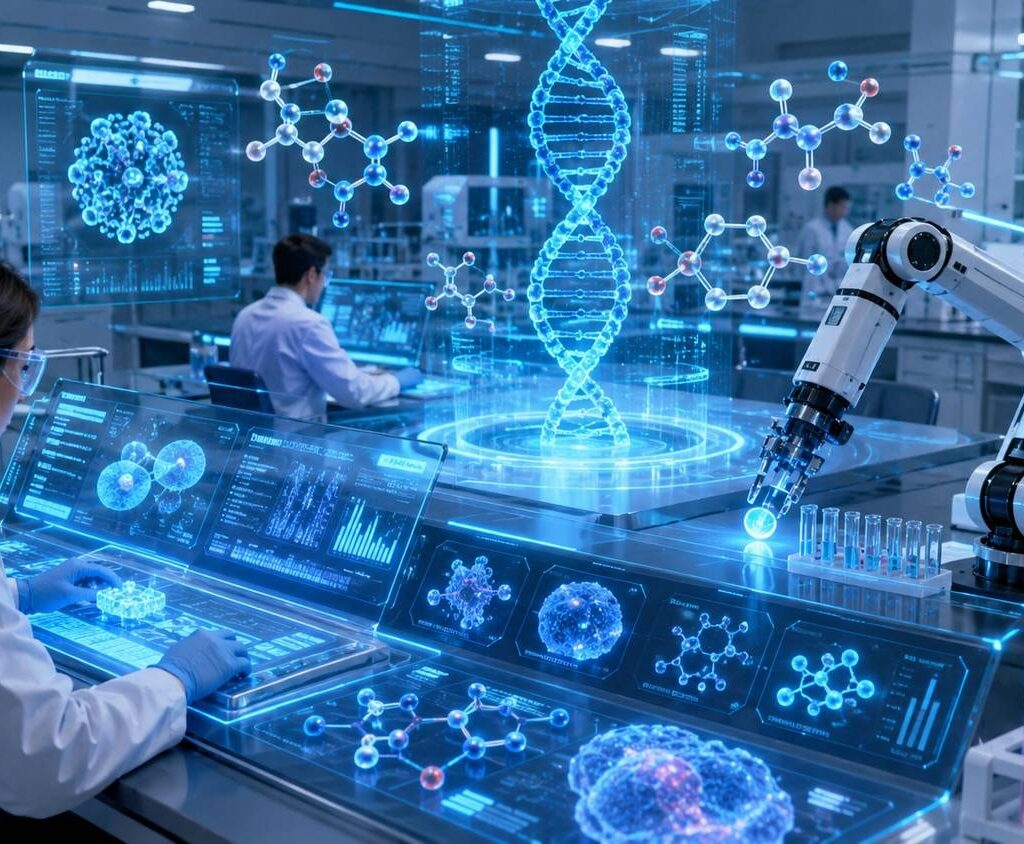

The traditional journey from discovering a promising drug candidate to bringing a new medicine to patients is long, expensive, and uncertain. On average, drug development can take more than a decade and cost billions of dollars, with many potential treatments failing during clinical testing. As healthcare challenges become more complex, pharmaceutical companies are increasingly turning to AI drug discovery platforms to improve efficiency, reduce costs, and accelerate innovation.
Artificial intelligence is transforming every stage of drug development, from identifying disease targets and designing drug molecules to optimizing clinical trials and predicting patient outcomes. By combining machine learning, deep learning, predictive analytics, and large biomedical datasets, AI-powered platforms enable researchers to make better decisions faster than traditional methods.
This article explores how AI drug discovery platforms are speeding up clinical trials, their role in modern drug development, the technologies behind them, their benefits and limitations, and what the future holds for AI-driven pharmaceutical research.
What Are AI Drug Discovery Platforms?
AI drug discovery platforms are software systems that use artificial intelligence to analyze biological, chemical, and clinical data to support the discovery and development of new medicines. These platforms integrate advanced computational techniques with biomedical research to identify promising drug candidates and optimize the entire research pipeline.
Unlike traditional drug discovery, which often depends on trial-and-error laboratory experiments, AI platforms evaluate millions of data points within hours. They identify hidden relationships between genes, proteins, diseases, and chemical compounds, helping researchers prioritize the most promising candidates for further testing.
These platforms often combine multiple technologies, including:
- Machine learning algorithms
- Deep learning neural networks
- Natural language processing (NLP)
- Computer vision
- Bioinformatics
- Molecular modeling
- Cloud computing
- High-performance computing
Together, these technologies provide researchers with faster, more accurate insights throughout drug development.
Why Drug Development Needs Artificial Intelligence
Developing a new medicine is one of the most challenging scientific processes. Researchers must identify disease mechanisms, discover suitable compounds, evaluate toxicity, conduct laboratory testing, complete several phases of clinical trials, and obtain regulatory approval.
Common challenges include:
- Extremely high research costs
- Long development timelines
- High failure rates during clinical trials
- Limited understanding of complex diseases
- Massive amounts of biological and clinical data
- Difficulty recruiting suitable trial participants
Artificial intelligence helps address these challenges by automating data analysis, predicting biological interactions, identifying potential risks earlier, and improving decision-making across the entire development process.
How AI Drug Discovery Platforms Speed Up Clinical Trials
Clinical trials are among the most expensive and time-consuming stages of drug development. AI significantly improves their efficiency in several ways.

1. Identifying Better Drug Targets
The first step in developing a medicine is identifying biological targets associated with a disease. AI analyzes genomic data, protein interactions, medical literature, and molecular pathways to uncover promising therapeutic targets.
Researchers can focus on targets that are more likely to produce successful treatments while avoiding less promising pathways.
2. Designing Better Drug Candidates
AI platforms evaluate millions of chemical structures using predictive models to determine which compounds are most likely to bind successfully with target proteins.
Generative AI models can even design entirely new molecules with desirable characteristics, reducing the need for extensive laboratory screening.
This significantly shortens the early discovery phase.
3. Predicting Drug Safety
Many drug candidates fail because of toxicity or unexpected side effects.
AI models predict:
- Toxicity
- Drug metabolism
- Drug-drug interactions
- Off-target effects
- Organ-specific risks
Early prediction helps researchers eliminate unsafe compounds before expensive clinical trials begin.
4. Selecting the Right Patients
Finding suitable participants is one of the biggest challenges in clinical research.
AI analyzes electronic health records, medical histories, laboratory results, imaging data, and genetic information to identify patients who meet trial eligibility criteria.
This improves:
- Recruitment speed
- Patient diversity
- Trial accuracy
- Enrollment efficiency
5. Optimizing Clinical Trial Design
AI simulations help researchers determine:
- Appropriate sample size
- Trial duration
- Endpoint selection
- Dose optimization
- Risk assessment
Better trial design increases the probability of successful outcomes while reducing unnecessary costs.
6. Monitoring Patients in Real Time
Modern clinical trials increasingly use wearable devices, remote monitoring systems, and mobile health applications.
AI continuously analyzes data from:
- Heart rate monitors
- Blood glucose sensors
- Smartwatches
- Remote patient monitoring devices
- Digital biomarkers
Researchers can detect safety concerns early and intervene before complications occur.
7. Improving Data Analysis
Clinical trials generate enormous amounts of structured and unstructured data.
AI automates data cleaning, identifies anomalies, recognizes patterns, and produces insights that would take human analysts weeks or months to discover.
This speeds up statistical analysis and supports faster regulatory submissions.
Technologies Powering AI Drug Discovery Platforms
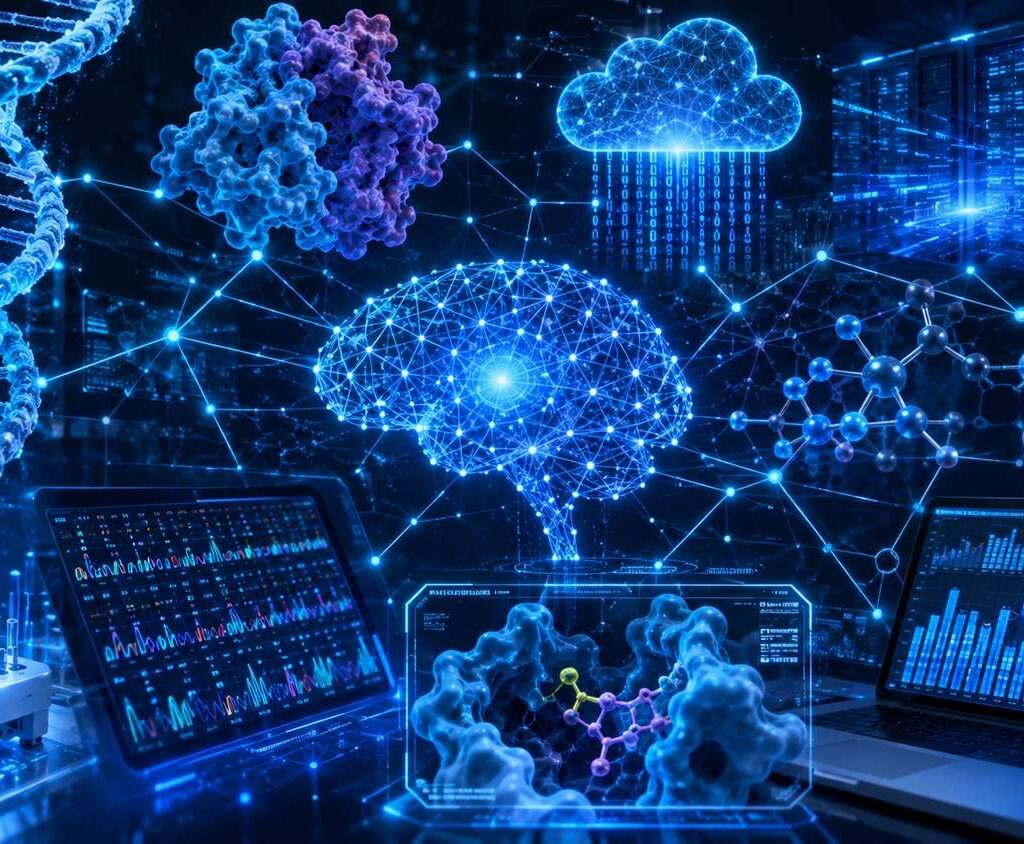
Several advanced technologies work together within AI-powered pharmaceutical platforms.
Machine Learning
Machine learning models identify patterns within historical drug development data, helping predict successful compounds and clinical outcomes.
Deep Learning
Deep learning excels at recognizing complex molecular structures, protein folding, and biological interactions that traditional algorithms struggle to analyze.
Natural Language Processing
Scientific publications, clinical trial reports, patents, and medical guidelines contain valuable information.
Natural language processing extracts knowledge from millions of research papers, allowing scientists to stay informed about emerging discoveries.
Bioinformatics
Bioinformatics integrates genomic sequencing, transcriptomics, proteomics, and biological pathway analysis to better understand disease mechanisms.
Cloud Computing
Cloud infrastructure provides scalable computing power for analyzing massive biomedical datasets and running complex simulations without requiring extensive local hardware.
Benefits of AI Drug Discovery Platforms
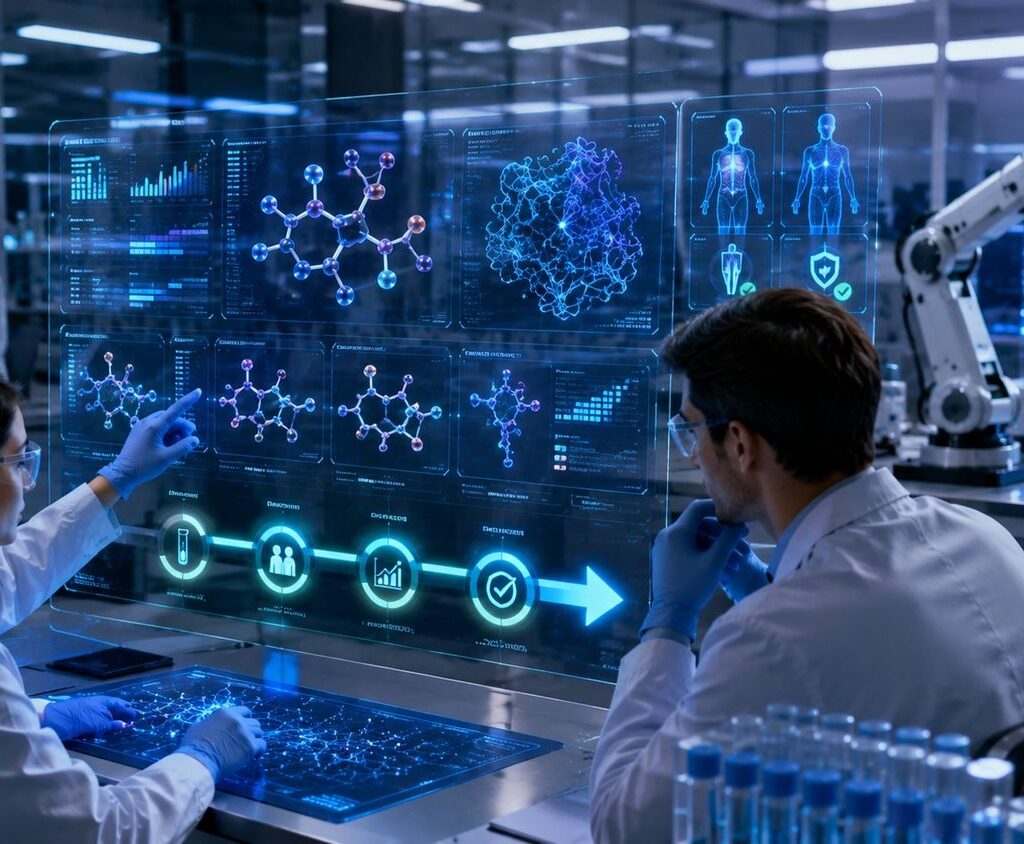
Artificial intelligence delivers measurable advantages across pharmaceutical research.
Faster Drug Discovery
AI dramatically reduces the time needed to identify promising drug candidates.
Tasks that once required months can often be completed in days.
Lower Development Costs
By eliminating weak candidates earlier, companies spend fewer resources on unsuccessful projects.
Reduced laboratory testing and improved trial efficiency also lower overall costs.
Improved Success Rates
Better target identification and predictive modeling increase the likelihood that promising compounds progress successfully through clinical trials.
Personalized Medicine
AI supports precision medicine by identifying treatments tailored to specific patient populations based on genetics, biomarkers, and disease characteristics.
Better Decision-Making
Researchers receive data-driven recommendations throughout the development process, reducing uncertainty and improving scientific confidence.
Real-World Applications
AI drug discovery platforms are already being used across multiple therapeutic areas.
Cancer Research
AI identifies novel biomarkers, predicts tumor behavior, and supports personalized oncology treatments.
Rare Diseases
For diseases with limited research, AI uncovers hidden genetic relationships and identifies opportunities for drug repurposing.
Infectious Diseases
During global outbreaks, AI rapidly analyzes viral genomes, predicts protein structures, and identifies existing medicines that may be effective against emerging pathogens.
Neurological Disorders
Researchers use AI to investigate Alzheimer’s disease, Parkinson’s disease, multiple sclerosis, and other complex neurological conditions where traditional research has been particularly challenging.
Drug Repurposing with Artificial Intelligence
Developing a completely new medicine requires years of research.
Drug repurposing offers an alternative by identifying approved medications that may treat different diseases.
AI analyzes:
- Molecular mechanisms
- Disease pathways
- Clinical records
- Scientific literature
- Real-world evidence
This approach became especially valuable during public health emergencies when researchers needed potential treatments quickly.
Challenges and Limitations
Despite remarkable progress, AI drug discovery platforms still face important challenges.
Data Quality
Artificial intelligence depends on high-quality, accurate, and representative datasets.
Incomplete or biased data can produce unreliable predictions.
Regulatory Requirements
Health authorities require strong scientific evidence before approving AI-assisted discoveries.
Researchers must demonstrate that AI-generated insights are reliable, transparent, and clinically meaningful.
Model Interpretability
Some deep learning models function as “black boxes,” making it difficult for scientists to explain why specific predictions were generated.
Improving explainable AI remains an active area of research.
Privacy and Security
Clinical research involves highly sensitive patient information.
Organizations must comply with data privacy regulations while protecting electronic health records and genomic data from cyber threats.
Human Expertise Remains Essential
Artificial intelligence supports scientists rather than replacing them.
Clinical judgment, laboratory validation, ethical oversight, and regulatory expertise remain critical throughout drug development.
The Future of AI in Drug Development
The next generation of AI drug discovery platforms will become even more integrated with biotechnology and precision medicine.
Emerging innovations include:
- Digital twins for virtual patient simulation
- Federated learning for secure multi-institution collaboration
- Quantum computing for molecular simulations
- Foundation models trained on biomedical data
- Multi-omics analysis integrating genomics, proteomics, metabolomics, and transcriptomics
- Autonomous laboratory systems combining AI with robotics
These advances have the potential to shorten development timelines further while improving treatment effectiveness and patient safety.
As computational power and biomedical data continue to expand, AI will become an increasingly important partner in pharmaceutical innovation.

Best Practices for Implementing AI Drug Discovery Platforms
Organizations adopting AI should focus on several key principles:
- Build high-quality, standardized datasets.
- Combine AI insights with laboratory validation.
- Maintain transparency in model development.
- Protect patient privacy through strong cybersecurity practices.
- Encourage collaboration between data scientists, clinicians, pharmacists, and regulatory experts.
- Continuously monitor AI performance using real-world clinical evidence.
Following these practices helps maximize the value of AI while maintaining scientific integrity and patient safety.
Frequently Asked Questions
AI drug discovery platforms are software systems that use artificial intelligence, machine learning, and biomedical data to accelerate the discovery, design, testing, and optimization of new medicines
AI improves patient recruitment, predicts drug safety, optimizes trial design, analyzes clinical data faster, and supports real-time patient monitoring, reducing delays throughout the trial process.
No. AI assists researchers by analyzing large datasets and generating predictions, but human scientists remain responsible for experimental validation, clinical decisions, and regulatory compliance.
Common technologies include machine learning, deep learning, natural language processing, bioinformatics, cloud computing, molecular modeling, and predictive analytics.
Drug repurposing involves identifying existing approved medicines that may effectively treat different diseases. AI helps identify these opportunities by analyzing biological and clinical data.
Major challenges include data quality, regulatory approval, model transparency, cybersecurity, privacy protection, and ensuring that AI predictions are validated through laboratory and clinical research.
AI has shown strong potential in cancer, infectious diseases, cardiovascular disorders, neurological diseases, autoimmune conditions, and rare genetic disorders.
Conclusion
AI drug discovery platforms are reshaping the future of drug development by making pharmaceutical research faster, smarter, and more efficient. From identifying therapeutic targets and designing drug candidates to improving clinical trial recruitment, predicting safety, and analyzing complex biomedical data, artificial intelligence is transforming nearly every stage of the development process.
Although challenges related to data quality, regulatory oversight, and explainability remain, AI continues to enhance collaboration between researchers, clinicians, and technology experts. Rather than replacing scientific expertise, these platforms strengthen it by providing data-driven insights that improve decision-making and reduce costly failures.
As artificial intelligence, genomics, cloud computing, and precision medicine continue to evolve together, AI drug discovery platforms will play an increasingly central role in delivering safer, more effective therapies to patients while significantly accelerating the path from laboratory research to clinical care.